Compared to high school the peer review process for me has changed a lot. For one, the purpose of doing peer review is slightly different. In high school for instance I would spend most of the peer review time only looking at local revisions. These are things like grammatical errors, small sentence structure mistakes, and if a paragraph was too short or too wordy. Compared to the peer review process now, while yes I do look for grammatical errors and things like wordiness, the main things I’m looking for are more big picture. This includes things like “does the overall paragraph get the point across to the reader?” Or “Does this source comparison have enough or your voice and does it make your stance clear?” Utilizing peer review for things like overarching themes and connections to the writers ideas/arguments makes the process much more effective. This always for one, a different perspective to look over the writing g which the author could add to their writing to make it appeal to a more diverse audience. And two, it always the authors writing to flow better because instead of small tweaks and changes, making more “bigger picture” changes always the writer to connect more with the reader.
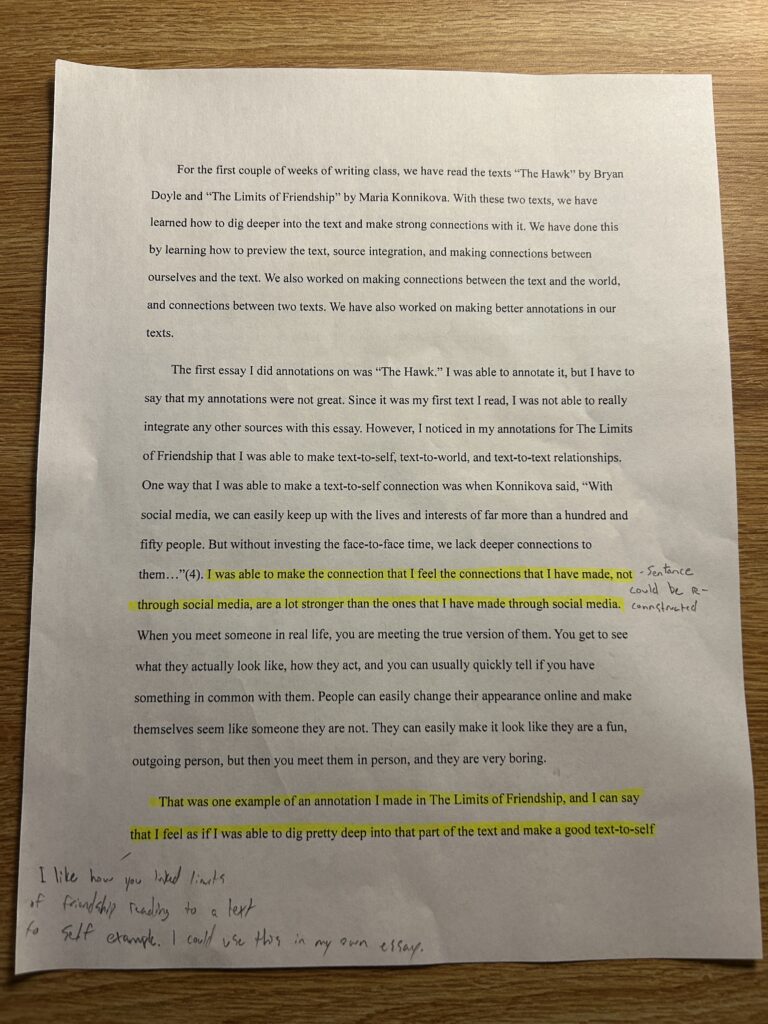
Classwork example of peer review/analysis or reading
This is an example of what a typical “peer review” might look like in high school. Not a lot and only focuses on small parts of the text. Nor do these annotations mention any sort of overarching themes or “big picture” items.
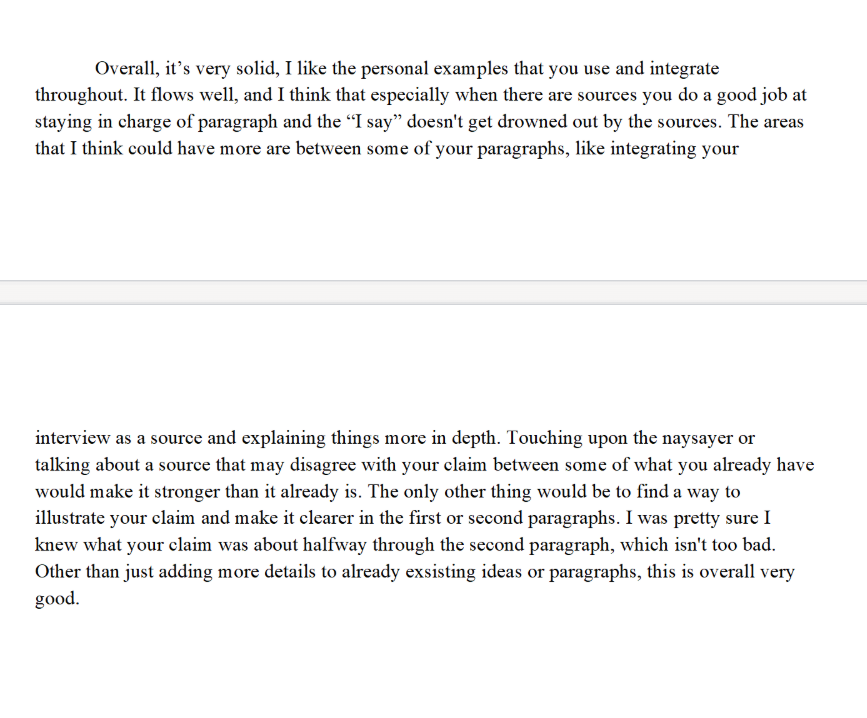
End Comment on peer review
This end comment is just one example of comments made on a classmates writing that I peer reviewed. This later example of a peer review piece of mine is an example of how I switched from focusing on local revision items in writing to more big picture, global revisions.
Over the course of this writing 110 class I have completed lots of reading responses and they have gradually gotten better over the semester. Either from more lengthy responses or more quality writing within my responses I have made improvements to my reading responses. Take my reading responses to “The Hawk” reading, I would just simply answer the question or briefly restate it and get into my immediate response.
“The Hawk” reading response questions
While some of my responses are lengthy a lot of the wording is just fluff, or rather pointless wording to add length to my response. I do restate the question that’s being asked in some of my responses with “The Hawk” reading but a lot of the structure is unnecessary. Compared to a reading response like Ross Gay’s “The First Incitement” reading responses the structure of my answers is more detailed.
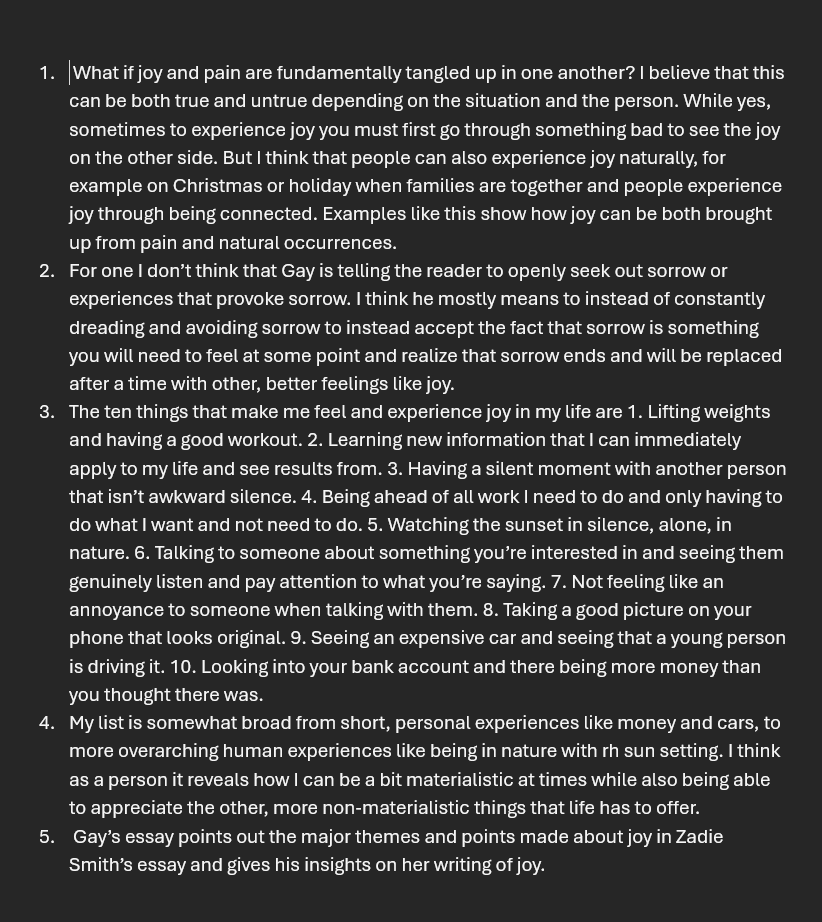
Ross Gay’s “The First Incitement” reading response
My responses in Ross Gay’s reading were more structurally sound. There isn’t a lot of unnecessary wording and I answer the question effectively while going into detail when I need to. Overall the structure and when and where I added necessary details are the main improvements to my reading responses over the semester.
The three main points in DFW’s speech were one, don’t be a slave to your own mindset. Two, don’t let yourself fall victim to your “default” settings or feelings. And three, try to see situations from other perspectives and to realize that there is usually more going on in most circumstances than what you can see. In DFW’s speech he repeatedly mentions the “default” setting, as seen in this quote “how to keep from going through your comfortable, prosperous, respectable adult life dead, unconscious, a slave to your head and to your natural default setting of being uniquely, completely, imperially alone day in and day out” (DFW 12). This quote relates to what I believe to be one of his main points, which is to not mindlessly make decisions and to instead think about and acknowledge your surroundings. I find myself agreeing with a lot of his points that he makes during his speech. Specifically, not going through life on “default” feelings or thoughts is what I found myself agreeing to the most. I personally have seen this with some adults that I have met where for years have defaulted to feeling resentment and like everyone else is in their way. I have seen how it makes it so that they are just going through the motions of everyday life and letting their thoughts dictate how they feel.
A specific quote that stuck with me from the speech was “It is not the least bit coincidental that adults who commit suicide with firearms almost always shoot themselves in: the head. They shoot the terrible master” (DFW 11). I don’t necessarily agree or disagree with this quote. I somewhat agree with the point he is trying to make here that is people can sometimes let their base instincts in their mind control their actions or thoughts. This can be tied back to the other point he makes which is to not be a slave to your own mindset and view things from other perspectives at times. I don’t believe however that this speech refers to empathy as the thing to default to or to feel more of towards others to experience more of what life has to offer. Instead, I think DFW is referring to what Paul Bloom’s alternatives to empathy are which are things like rational compassion and moral/reasonable decision making. Making a conscious effort into experiencing life to the fullest and to not having resentment towards others.
Three main points that the author is making here is that one, empathy has a narrow focus; two only lets us focus on the few not the many; and three, empathy allows our own biases to dictate where our empathy is directed. As seen in this quote, “but spotlights have a narrow focus, and this is one problem with empathy. It does poorly in a world where there are many people in need” (Bloom 1). This quote from Bloom is an example of one of the points he is trying to make which is that empathy is narrowly focused at times. I find myself agreeing with a lot of Blooms points that he makes about empathy. He didn’t necessarily challenge any initial beliefs I had about empathy, his argument made me think about empathy in a deeper, more complex way than I had before. I don’t believe however that my opinions changed on empathy because of bloom’s points.
A claim in Bloom’s writing that he included to invoke a stronger response was “empathy is limited as well in that it focuses on specific individuals” (Bloom 2). This claim he makes that empathy can only focus on the few not the many is something I find myself agreeing with. Even in my own experiences, either giving or receiving empathy I realize looking back that people can only give so much empathy at one time. This makes it hard to have empathy for many individuals affected by an issue or that need empathy.
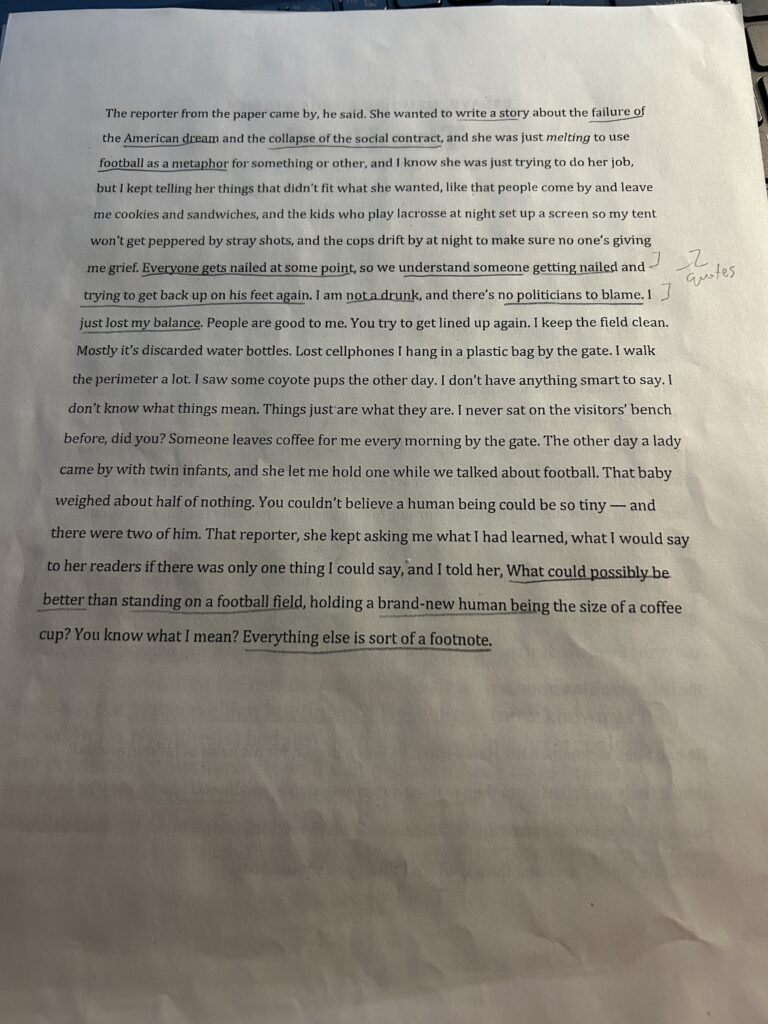
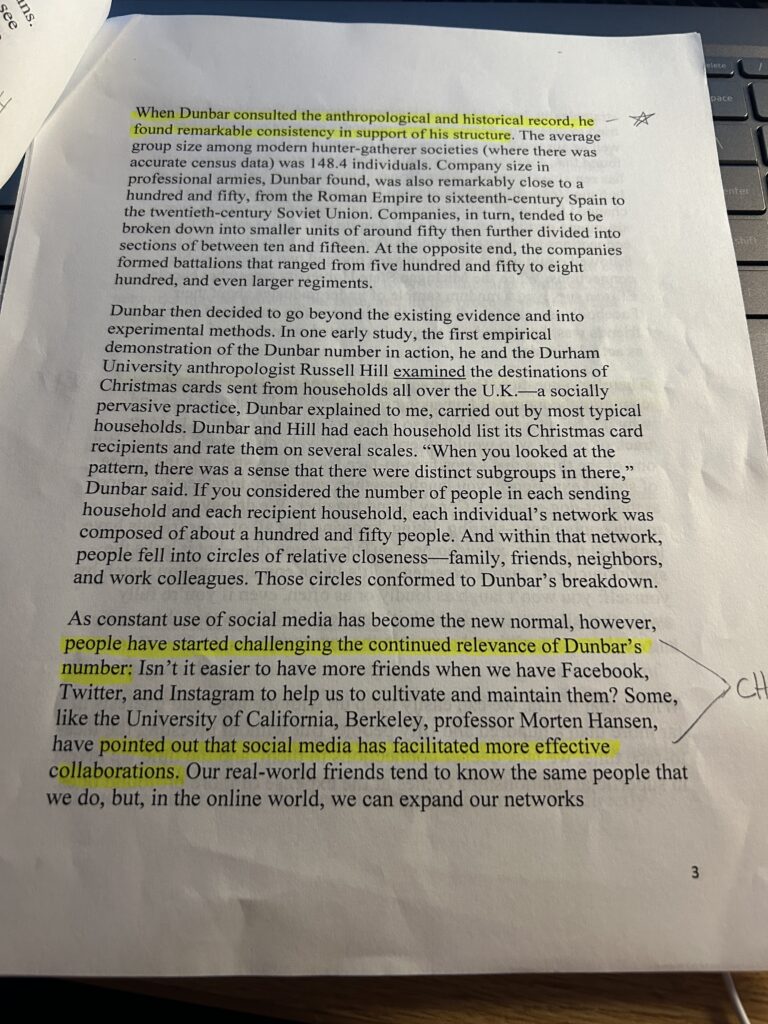
My reading responses as well as my note annotations for “The Hawk” reading and up until “The Limits of Friendship” reading have undergone some minor as well as some major changes. The first annotations for “The Hawk” reading weren’t very organized and were done after reading the full passage. I underlined sentences and parts of the text that seemed important but didn’t connect to any themes or ideas of the overall passage or my interpretation. As seen in the image below, my annotations from “The Hawk” were very basic and lacked any detail or explanations for their importance. For example one of the sentences the annotation or underlined part was this sentence from the reading “everyone gets nailed at some point, so we understand someone getting nailed and trying to get back up on his feet again” (Doyle 2). Comparing this annotation to a more recent, more detailed annotation from the “Limits of Friendship” reading which was “people have started challenging the continued relevance of Dunbar’s number” (Konnikova 3). The “Limits of Friendship” quote that I annotated was pointing out a part of the reading where the author was challenging a psychologist’s view with her own. Where as my annotation from the “The Hawk” was just a piece of dialogue that stood out to me from the text. Not only did my early annotations not have any explanations but they weren’t grouped into categories based on different types of information throughout the text. This made the notes harder to use in later assignments and harder to connect my own interpretation of the text. My annotations and notes for the hawk were more just surface level and things that stood out to me in the moment. These notes weren’t very deep and didn’t connect to any overall theme or big picture of the text.
Jumping forward to the “Limits of Friendship” text my notes and annotations became more detailed and focused more on the overall theme/message of the text and less on what stood out in the moment. The image below from “The Limits Of Friendship” reading my annotations not only stand out more but have blurbs on the side relating to specific writing themes. Not only did I underline things as I read the text, but I also went back and made small notes as to why they were underlined. I connected the things I was underlining to the different kinds of annotations like parts of the text I was understanding, parts I was questioning, or parts that push the author’s idea in a further direction. Doing this made it clearer as to why these parts of the text were underlined. Not only were these notes clearer as to why they were underlined in the first place, but it also made it easier to go back and reference them. For example, in “The Hawk” reading the only notes that I did were brief, underlined portions of the text that didn’t have any explanations to explain why they were underlined. But looking at my notes from the “Limits of Friendship” the parts that I underlined had specific annotation labels next to them that I could look back at and know why they were important.
Looking at my notes from “The Hawk” reading up until the limits of friendship reading it’s clear that more detailed, organized notes/annotations are needed for understanding the text. Not only are more detailed notes used for understanding the text better, but it also makes it easier to look back at those notes to help in future writing assignments and to connect themes of previous readings to current ones. As shown in the two pictures below the difference is not only clear in the detail of what in the readings was specifically underlined; but the method of which I pointed these parts of the reading out were different visually as well.